- January 31, 2025
B2B Portal Development
B2B Portal Development for Manufacturers, Distributors and Wholesalers
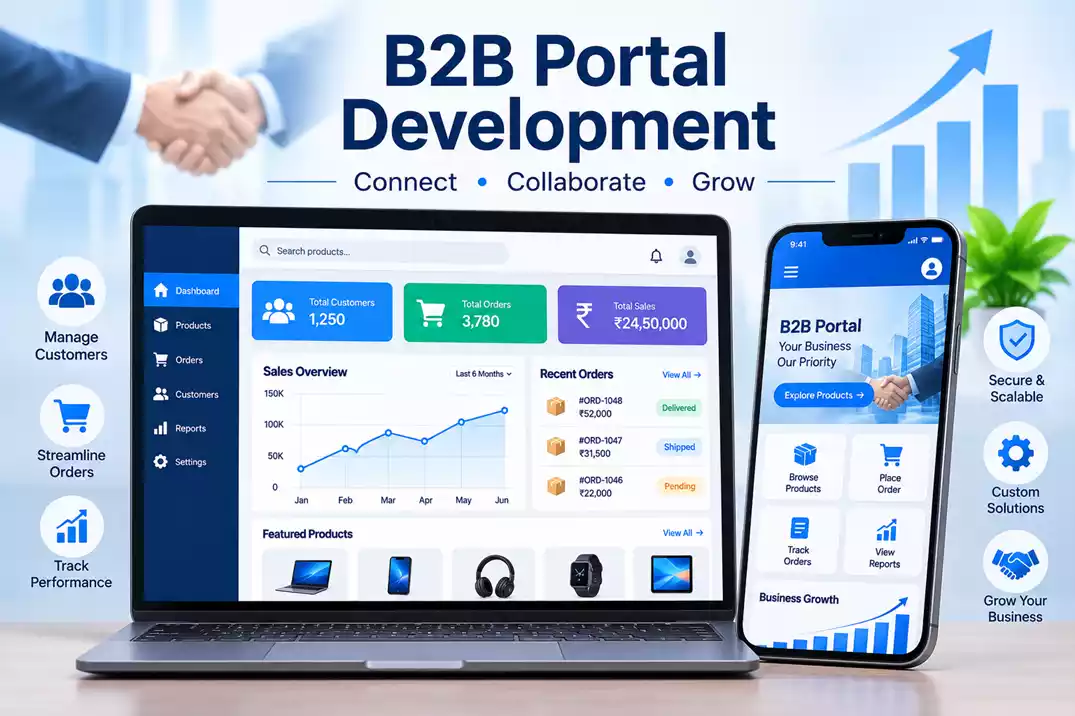
Trade buyers do not want to browse. They want to reorder what they bought last month, at the price you agreed, and see what is in stock before they commit. Our B2B portal development service gives your dealers, distributors and business customers a login where they can do exactly that, any hour of the day, without waiting for a phone call back. Dench Infotech designs and builds these portals for Indian businesses and connects them to the accounting and ERP software you already run.
The kinds of B2B portals we build
The word "portal" covers several different products, and the right one depends on who logs in and what they need to do.
- A B2B ordering portal, where buyers place and repeat orders against your price list.
- A dealer or distributor portal, with territory rules, dealer pricing, stock visibility and scheme tracking.
- A B2B customer portal, where business clients check orders, download invoices and raise support requests.
- A partner or vendor portal for onboarding suppliers, sharing documents and handling purchase orders.
- A B2B ecommerce portal that sells to businesses online, with company accounts and bulk pricing.
- A B2B marketplace, where several sellers list products for many business buyers.
Features that matter to trade buyers
A consumer store treats every visitor the same. A trade portal cannot. Two dealers can see different prices for the same item, one can have a credit limit while another pays in advance, and a purchase over a certain value may need a manager's approval before it reaches you.
These are the building blocks we put together for you:
- Company accounts with roles, so a buyer, an accountant and a branch manager each see and do only what their job needs.
- Contract and dealer specific pricing, price lists, discounts and credit limits.
- Quotes and requests for quotation (RFQ), with approval steps for large orders.
- Bulk upload, saved lists and one click repeat orders.
- Live stock and order status pulled from your own records.
- Invoice, ledger and statement downloads without a call to your accounts team.
- Assisted ordering, so your sales team can place an order on a dealer's behalf from the same screen.
- Email and SMS alerts for order updates, dispatch and payment reminders.
- Reports on dealer sales, reorder patterns and slow moving stock.
Built for Indian invoicing and GST
This is where many imported portal templates fall short. Indian trade runs on GST documents, and your portal has to fit around them.
Businesses with an aggregate annual turnover above ₹5 crore must issue e-invoices, and an invoice without an authenticated Invoice Reference Number (IRN) and QR code is not valid under the e-invoicing rules. Goods worth more than ₹50,000 in one consignment generally need an e-way bill, as the GST Council's own guide explains.
So we map the order flow before we build it. We decide where the order becomes an invoice, which system raises the IRN, and how the buyer's GSTIN, ship-to address and tax details travel with the order. Your finance team should not have to retype a portal order into the accounting software.
Connecting the portal to your ERP and accounting software
A portal that keeps its own copy of prices and stock goes wrong within a week. Someone updates a rate in the accounts system, the portal still shows the old one, and a dealer orders at the wrong price.
We connect the portal to the software that holds the truth, whether that is Tally, Zoho, SAP or another ERP, so prices, stock, orders and ledgers stay in step. Some systems offer clean APIs and others need a middle layer, and we check which one you have before we promise a timeline. Our API integration services team handles this part of every project.
Why a portal and not just an ecommerce store
An online store is built for strangers who pay at checkout. A portal is built for known accounts, negotiated terms and repeat buying. If you sell to the public as well, we can run both from one catalog, and our ecommerce website development work covers the retail side. For trade customers, though, a login based portal with approval rules and account pricing is the better fit.
Who we build for
Manufacturers who sell through dealers, wholesalers and distributors with a large buyer list, and traders who spend half their day taking orders on the phone will see the fastest return. Our retail and wholesale system work is a close cousin of this service. Financial service firms with agent or partner networks use portals too, and so do startups and organisations that want to bring their first business customers online without building a full platform.
How a B2B portal project runs
- We sit down with you and your sales and accounts teams and walk through how an order actually travels today, from enquiry to payment.
- We write down the rules: who sees which price, who approves what, and what happens when stock runs out.
- We design the screens around those rules and show you clickable pages before development starts.
- We build the portal and the ERP connection, then test with real orders from your own price list.
- We onboard a few friendly dealers first, fix what they find, and then open the portal to everyone else.
Getting your dealers to actually use it
The best portal is useless if buyers keep phoning in. We keep the login simple, make every page work on a phone, and build a quick reorder screen because that is the task trade buyers do most. If your buyers live on their phones, we can also build a companion app through our mobile app development team.
Buyers are more ready for this than many sellers assume. McKinsey's February 2022 B2B Pulse, a survey of about 3,500 decision makers in 12 markets, found that a majority were willing to spend at least $50,000 through remote or self-service channels. The data is a few years old, but it points one way.
Security and access control
A portal holds your price lists and your customers' order history, so access has to be tight. We use role based permissions, encrypted connections, activity logs and strong password rules, and we set up approval limits so one stolen login cannot place a huge order.
Questions people ask us
What is B2B portal development?
It is the design and build of a secure website where business customers, dealers or suppliers log in to order, track, pay and communicate with you. It usually connects to your ERP or accounting software so the data stays accurate.
How is a B2B portal different from an ecommerce store?
A store sells one price to anyone who visits. A portal serves known accounts with their own prices, credit terms, approvals and order history.
Can you connect the portal to Tally, Zoho or SAP?
Yes, in most cases. We review your system first, because the method depends on what interface it offers. Some need a direct API and some need a middle layer.
How much does a B2B portal cost?
The price depends on the portal type, the number of user roles, the pricing rules, and how many systems it connects to. We give a fixed quote after a scoping call, not a number picked from a chart.
How long does it take to build?
A focused ordering portal takes less time than a marketplace with many sellers. We give you a schedule once we have mapped your order flow and checked your ERP.
Do you maintain the portal after launch?
Yes. Prices, tax rules and buyer needs keep changing, so we offer ongoing support and updates.
Tell us how your orders work today
Share how your dealers and business customers place orders now, and where it slows down. We will suggest the right portal type and a plan. Request a quote or contact our team, call us on 9650-848-208, or write to info@denchinfotech.in. You can also look through our portfolio or visit us at 4th Floor, Gaur City Center, Noida Extension (U.P.), or 13/30 Third Floor, East Patel Nagar, New Delhi.